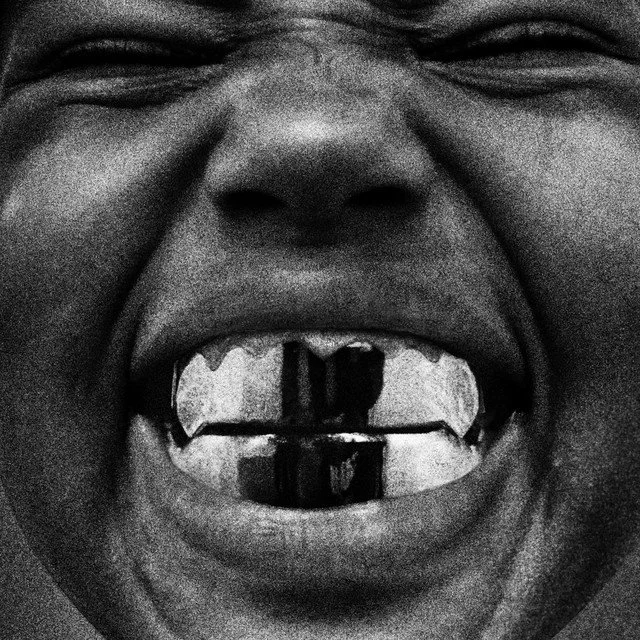
Ye
BULLY
Unfinished and fragmented, ‘Bully’ shines in glimpses but, like Ye himself, is messy and tarnished by his recent controversies
★★
“BULLY ON THE WAY NO AI.” stated Kanye West, now known as Ye, in a post on his social media last week.
It may seem unassuming and even non-controversial to declare that on your new album, you won’t be utilising AI technology. As with most of Ye’s actions over the past couple of months, however, it’s part of a hastily arranged whistle-stop apology tour. It follows a singular ad taken out in the Wall Street Journal, asking for forgiveness for his highly-publicised, extensive and abhorrent anti-semitic tirades that included dressing in KKK garments and releasing an ode to Hitler. All in the hope of convincing the wider public to accept him, his new music, and return to touring.
There was always a question over how far Ye could push it. What outburst, what awards speech, what vitriol would finally teeter him into pariah territory? Ye is an artist who has lived creatively and personally on the brink. His Bipolar Disorder has long been documented, as has whether it can account for his horrific anti-semitism, adoration of Hitler and persistent abuse of the Jewish people. Regardless, it’s certainly pushed him to the point where he cannot afford to burn bridges anymore and finds himself at the only point in his career where he’s catering to the needs of others, albeit selfishly for his own benefit.
The latest, his declaration of removing artificial assistance from an album, whose early demos were riddled with it, is an act to appease his hardcore fans. Ye fans are highly accustomed to his increasingly irate, volatile and deeply offensive behaviour over the last decade. Still, ironically, it’s been his use of AI technology to replace and sterilise his creativity that has become the most offensive output of Ye’s in recent months for them. Ye has never been afraid to embrace modern forms of technology to innovate, but his uncanny-valley transition into computer-generated Spanish singing and altering other rappers' vocals to sound like his own became a step too far for Ye’s most devoted followers.
So it’s gone, the resulting version of ‘BULLY’ we’ve been left with is stripped of AI. This may play a part in explaining the fractured state of the album. Tracks often feel half-finished and struggle to reach the two-minute mark (the average length of each track is a mere 2:22). Albeit full of sprawling hooks and earworm choruses, they’re lacking the lyrical wittiness and depth Ye has made a hallmark of his career.
Whilst there’s no AI used artistically, you can’t help but feel Ye restarted the album by asking ChatGPT, “What would Kanye West’s greatest hits sound like? How can I get them to forgive me?” It’s an absolutely fascinating point in Ye’s artistic career. At his peak, he would have double-downed on any form of pushback, funnelling the entire album through AI software to make a point obtrusively.
This is because, artistically, he’s always been proven right in the end. He’s definitely had misses, much more often than not in the last decade, with bloated album releases that at best border on filler and at worst, garbage. But they’ve been bold, creative risks. ‘Jesus Is King,’ for example, was met with confusion from both critics and fans, yet his innate ability to create incredible music was undeniable on the track ‘God Is’, which is only now getting its due, almost eight years later, going viral due to its beautiful melody and undiluted yearning of hope.
For the first time now, though, he’s appeasing fans rather than challenging them. All the hits are here: recognisable soulful samples, thunderous production and drums, religious imagery, futuristic synths and lyrics hinting at redemption. There’s even once again an ode to his late mother, pulling at your heartstrings. He has never, regardless of which sonic era he’s inhabiting or mental state he’s in, trodden old ground before. Here, he’s stomping across it, and the resulting album is a mess.
Whilst ‘BULLY’ is undoubtedly Ye’s first listenable, cohesive album in years (both the provocative and at times despisable VULTURES records and the spiralling DONDA 2 were borderline abject). BULLY feels like a fast-food meal designed to delight in bursts and not outstay its welcome. Each of Ye’s previous records had a distinct flavour to it and existed in its own sonic world. Whilst neither artist would appreciate the comparison, as with Taylor Swift, you always knew what ‘Era’ you were immersing yourself into.
‘BULLY’, meanwhile, is beige, bland and fuelled purely by that nostalgia. For everything the album reminds you of, you can’t help notice what is glaringly missing. That’s not to say the record is without its merits. ‘ALL THE LOVE’ channels what makes Ye such a master of production. Reminiscent of his ‘Life Of Pablo’ era output from a decade ago, it’s a sign of an artist who still, somewhere, has his finger on the pulse of current music trends. His autotuned vocals on the track feel incredibly vulnerable and the way the track transforms and channels emotions in just an urgent thudding drumbeat is a marvel. Likewise, ‘SISTERS AND BROTHERS’ mixes elements of house, dark gospel and soul in ways only Kanye has ever managed. Both manage to hit a very small sweet spot of reminding you of how gifted of a composer Ye is; that skill hasn’t left him.
The problems quickly arise when you realise what is missing, the moments of poetic or witty lyrical flare that made Ye such a multifaceted marvel. There is no better wordsmith amongst his peers; only Kendrick Lamar can come close to the emotive ability, witticism and genius lyricism seen across Ye’s first five records. A timeless run, which makes the absence of any semblance of deep thought in his words here more painful.
‘HIGHS AND LOWS’, the redemptive heart and highlight of the album, is incredibly frustrating. It noticeably calls back to Ye’s 2016 highlight ‘Wolves’ with synth-pitched howls that rise like a choir around a yearning chorus that pleads to his fans to stick with him. Yet, it’s missing any semblance of a verse or message. Whereas previously this powerful chorus would be bookended by heartfelt insights into Ye, perhaps a witty double entendre or two, but that’s all gone.
There’s also, ‘I CAN’T WAIT’, a track centred purely on the iconic ‘You Can’t Hurry Love’, in which your enjoyment of the track comes from one of the most acclaimed Motown songs of its generation and nothing that Ye has layered or tweaked on top of that. This, too, is followed by ‘WHITE LINES’, an apparent cover of The Carpenters ‘Close To You’, a carbon copy of the unique, beautiful rendition Frank Ocean already perfected on his 2016 opus ‘Blonde’. Which begs the question, what is the point? Ye doesn’t improve these moments; he’s bastardising iconic melodies and content, hoping their timeless qualities will improve the slop being provided to the listener.
Then a large quantity of the record is unfortunately passive filler, as Ye regularly struggles to either flesh out interesting ideas on scattered demos that, as mentioned, amount to little more than a chorus. Many of these are easily forgettable; ‘KING’ and ‘THIS IS A MUST’ feel like irrelevant old recycled material, as does the lacklustre chipmunk-pitched soul of ‘PUNCH DRUNK’ and ‘WHATEVER WORKS’. Then there’s ‘LAST BREATH’, a sharp and surprising swerve into Spanish-language Reggaeton, which feels laughable when the bar has been set so high these past twelve months by Bad Bunny and Rosalia.
It feels harsh to pile on to Ye here, but it’s a record that leaves you constantly grappling with frustration. There’s no excusing Ye’s actions over the last decade. His creativity, his desire to break boundaries and cross new musical ground, was never in question, though. That is, until now. For the first time, Ye has hesitated; he’s tried to appease, to make music that tries to remind people of the ‘Old Kanye’. Now that the unwavering dedication to his craft, refusal to doubt his sound, and intriguing wordplay have gone, you’re just left asking what’s left?